Welcome to the post-event resource hub for the NHS North West Festival of Leadership 2026. This page brings together presentations, articles, videos and development resources shared by speakers and contributors, offering opportunities to explore the themes discussed throughout the Festival in greater depth. Participants are encouraged to use these resources to support ongoing learning, reflection and collaboration as they continue to develop their leadership practice and shape the future of health and care across the North West.
Welcome and opening address
Kicking off the day, Silas Nicholls highlights that future-ready leadership requires thinking differently and collaborating with partners across sectors as the healthcare landscape continues to evolve. As Chair of the NHS North West Leadership Academy, he mentions how he finds the support from the academy beneficial personally as well.
This is then followed by a speech from Dr Frances Dodd celebrating the impact of the NHS NWLA and its membership offer, including…
- £155,320 saved through providing local delivery of the Mary Seacole programme.
- 209 events, webinars and workshops provided with over 3.4k participants.
- 2111 hours of coaching and mentoring support.
- 87% of boards have scoped or accessed executive development.
Frances highlighted the NHS NWLA commitment towards anti-racism, the implementation of the NHS Leadership and Management Framework, and the North West Executive Hub.
The session also featured the NHS North West Leadership Academy’s Leadership Reflections video, showcasing perspectives from leaders across the region on the future of leadership in the NHS:
Keynote talk | Louise Shepherd CBE
“The future of health and care in the North West will be determined by thousands of leadership choices. Choices to collaborate rather than compete, to include rather than exclude, and to act with courage rather than seek comfort.”
That was one of the key messages from Louise Shepherd CBE as she delivered a keynote on leading through a time of profound change at the NHS North West Festival of Leadership this morning.
Louise emphasised that no single team or organisation can solve the challenges facing our communities alone. She also spoke candidly about the pressures facing health and care, and just as clearly about the progress being made when organisations work together.
Her closing advice has offered three reflections for leaders at every level:
- Hold on to purpose: Structures and priorities may change, but the aim of improving outcomes, access and experience, and reducing inequalities remains.
- Lead with courage and compassion: The leaders people remember are those who showed up, listened and treated others with dignity.
- Make all voices heard: Inclusive leadership means fair opportunity, recognised talent and diverse perspectives shaping decisions.
Panel | Leading with a heightened level of accountability
What happens when accountability becomes more about assurance than improvement? Our panellists shared some thought-provoking perspectives.
Aaron Cummins, Chief Executive of NHS Lancashire and South Cumbria ICB, challenged the NHS to focus as much on improvement as it does on assurance and box-ticking. He also highlighted the importance of celebrating those who take on difficult leadership roles, not just those who deliver the strongest performance.
Alison McKenzie-Folan OBE, Chief Executive of Wigan Council, spoke about maintaining a values-led culture under pressure. Wigan’s approach centres on being asset-based, accountable, positive, courageous and kind, with high standards upheld compassionately.
Salman Desai KAM, Chief Executive of North West Ambulance Service NHS Trust, warned that when the response to problems is punitive, people stop speaking up. Leaders must create space for openness while having the courage to challenge repeated failure.
Professor Sarah O’Brien, Chief Nursing Officer at Mersey and West Lancashire Teaching Hospitals NHS Trust, highlighted the importance of accountability to the population we serve and knowing what is going on in your organisations from the basics to the big headline issues.
Related resources
Mission Leadership
at Wigan Council
A Guide for Leaders and Managers
HSJ article: ‘Organisational shame’ driving defensive behaviour at inquiry trust
Leading analogue cultures to digital cultures
Moving from analogue to digital cultures starts with people, data and system collaboration. In one of the workshops this afternoon, three NHS leaders offer practical insights.
On building digital capability, Ian Gilbertson from the Alder Hey Children’s NHS Foundation Trust makes the case that real capability is built through people’s involvement in shaping and testing the solutions. And technology should adapt to the service and staff, rather than the other way around.
On unlocking the value of data, Wes Baker (ACMA,CGMA, CPFA) from the The Christie NHS Foundation Trust shares the pathway to an intelligent hospital, where data moves from a supporting function to core infrastructure. It demonstrates how a Single Data Platform can join up clinical, operational and research data to improve cancer care.
On enabling integration, Cara Afzal from Health Innovation Manchester draws on the GM care record and outlines that integration is a culture challenge at heart. It calls for trust, shared responsibility, clear governance, distributed leadership across systems, and inclusion by design.
Related resources
Leadership Live: Neurodivergent superpowers and the AI revolution
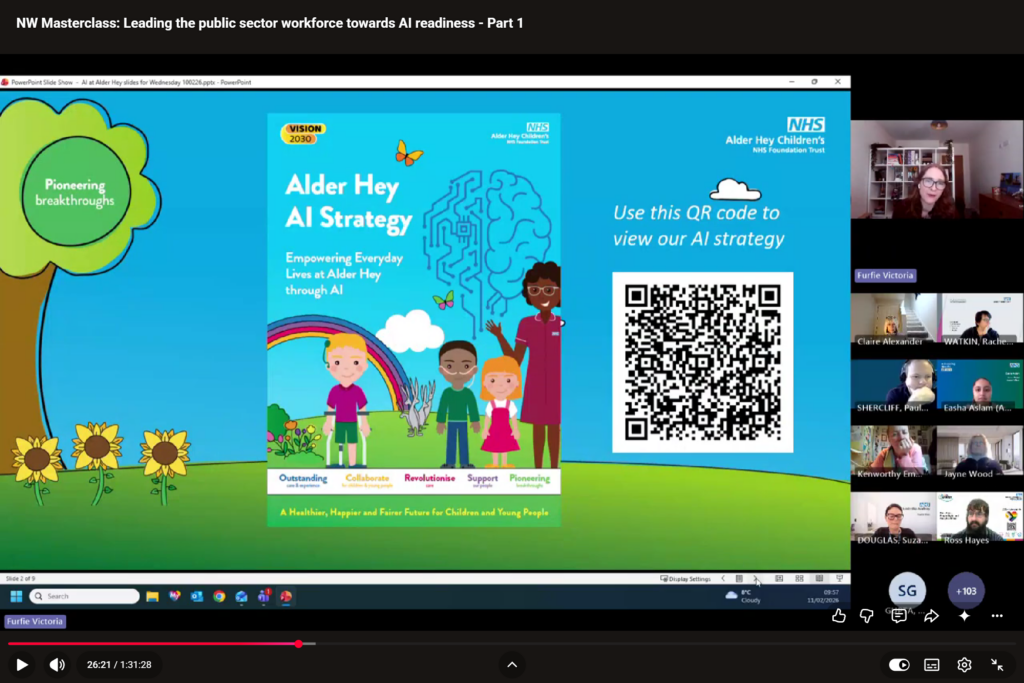
Leading the public sector workforce towards AI readiness

System Leadership Behaviours Framework
Neighbourhood development: Leading in Place
People’s health and wellbeing are shaped by the places where they live, work and connect. And leading in Place often means rethinking how support shows up for those in need.
Bringing perspectives from local government, primary care, and neighbourhoods, Mike Barker, Dr Paula Cowan, Rob Larcombe and Warren Heppolette explore how systems can move from organisational delivery models towards integrated, community-centred approaches.
Key takeaways from this workshop:
- Integration should allow people to get the correct, timely help without repeating their story or being passed between services.
- Wider family context matters. Services should focus on enhancing the conditions for families to thrive instead of treating each problem in isolation.
- Effective prevention requires working on three levels of capacity: building community strengths, acting early on emerging risk, and offering intensive support for complex needs.
- Use data and local insight to spot needs early, then act through trusted community relationships.
Related resources
Leadership Live: Overcoming barriers to clinical leadership” with Dr Paula Cowan
Leadership Live: Strengthening our communities with Mike Barker

Leadership Live: Prevention in action
Leading in a political environment: Beyond Westminster
Sharing his experience of working in a political environment, Cllr Keith Cunliffe, Deputy Leader and Portfolio Holder for Adult Social Care, Wigan Council, urged delegates to “Get your trainers on and go out in your community – they often have the solutions.”
Gillian Bishop, Chief Executive, North West Employers, reiterated the importance of colleagues focusing on people, our community and our residents. “It’s important to approach with curiosity. How do we wrap support around them – rather than expecting people to navigate the complexity themselves?”
What do you need to build on your current experience in a political environment? We are designing the return of our Political Partnerships event; what should we consider when developing this?