Sustaining cultural improvement through change
Mersey Care NHS Foundation Trust

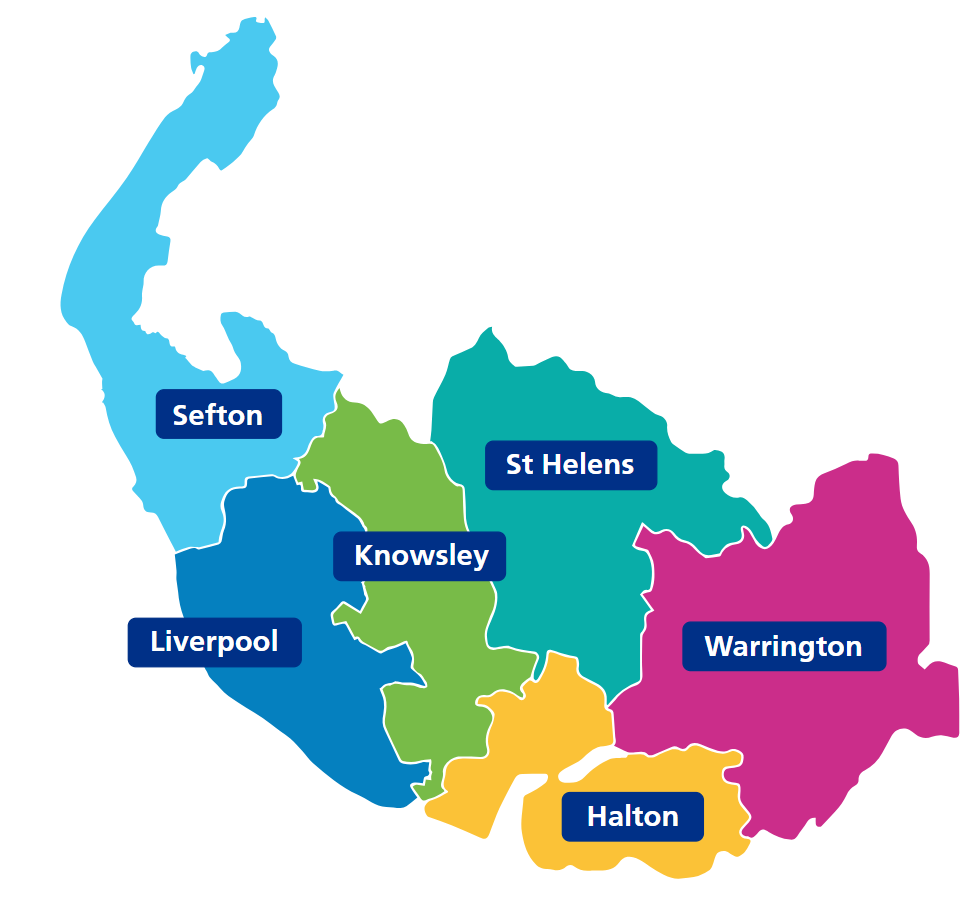
Mersey Care are a community and mental health, learning disability (MHLDA) NHS Trust in the North West of England. They are the largest provider of 0- 19 services across Liverpool and Sefton. They are one of only three MHLDA organisations with high-security inpatient services. They have 11,000 colleagues and provide community and mental health services to a population of 1.4 million, and clinical services are provided over 236 sites, spanning a large part of the North West.
A restorative and just culture
Mersey Care NHS Foundation Trust experienced a rapid period of growth from 3,000 staff in 2016 to 11,000 in 2021, following a series of acquisitions and large-scale change. Throughout this period, and throughout the pandemic, the Trust maintained a clear focus on organisational health and restorative just culture, with a particular focus on staff engagement and development, compassionate leadership and team health, which are regarded as critical enablers to clinical quality and safety.
From 2021 – 2023, the annual Staff Survey results indicated sustained, incremental improvements in staff engagement during a challenging period for the organisation, as a result of strategic, comprehensive communication plans that have been operationalised and cascaded throughout the organisation, divisions, services and staff groups. This included a refresh of planning and arrangements to support the next phase of EDI, antiracism and staff networks in the trust.
As the trust’s strategic intention is to have ‘highly engaged and supported staff’, a refreshed approach to staff engagement was undertaken in 2024 to identify the high-impact actions that would make a positive difference to staff, and a renewed focus and rigour on staff engagement overall.
Embedding a positive culture
Through the Organisational Effectiveness Team, Mersey Care NHS Foundation Trust had invested significant time and effort into embedding the foundations required for a positive culture; developing and maturing leadership capability and providing the tools and frameworks for “Every Leader, Every Team” to thrive.
The trust was able to build on these foundations and focus on the following with the aim of improving overall staff experience.
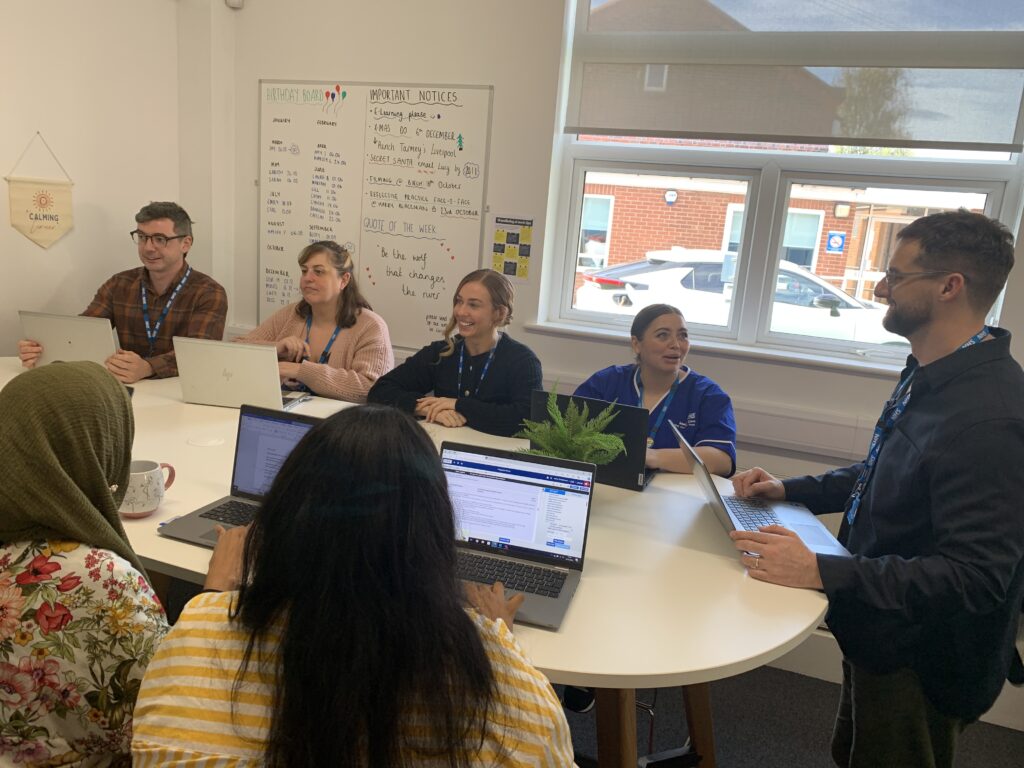
They invested time and resources into leadership and local ownership through:
- A, Your Voice, Your Change engagement programme understanding the lived experience of their people, identifying actions that will have the biggest positive impact, and a collaborative, coordinated approach to creating change based on staff feedback.
- Establishing the Team Canvas as a mechanism for systematically cascading team-based working across the organisation. Each team is asked to refresh its Team Canvas annually to ensure the effective cascade of the trust’s operational plan.
- A robust and extensive leadership development offer, underpinned by the Operational Excellence criteria and leadership competencies focused at different levels of confidence: Aspire, Arrive, Strive, Thrive and Drive for different levels. This includes ring-fenced places for colleagues from protected characteristics, and the Aspire programme aimed at under-represented groups.
- A coaching and mentoring offer for managers and leaders.
- Embedding of a Just and Restorative Culture approach to support psychological safety and learning.
- Assertively developing clear team ownership of engagement and people issues – including having these woven into internal quality review visits by the nursing team, which emulate CQC visits. Divisional teams also had their own Your Voice, Your Change action plans.
- Empowering Freedom To Speak Up Guardians (FTSU) in each Division to become well embedded and active, with high profiles.
- Launched a Live, Work, Flex campaign to promote awareness of flexible working options. This included 2 team-based rostering pilots. Senior leaders also engaged with an NHS England pilot Flexible Leadership programme designed to get leaders thinking differently about work-life balance.
- High-quality, values-based PACE appraisal and supervision (consistently exceeding the trust’s 90% KPI).
Improved staff survey scores and retention
Mersey Care benchmarked consistently across all 9 themes as a “strong and improving” organisation in the Staff Survey 2024 results, meaning that they benchmarked in the top half of scorers and saw statistical improvement.
Particular improvement has been seen with “We are a Team” and sub-scores relating to leadership.
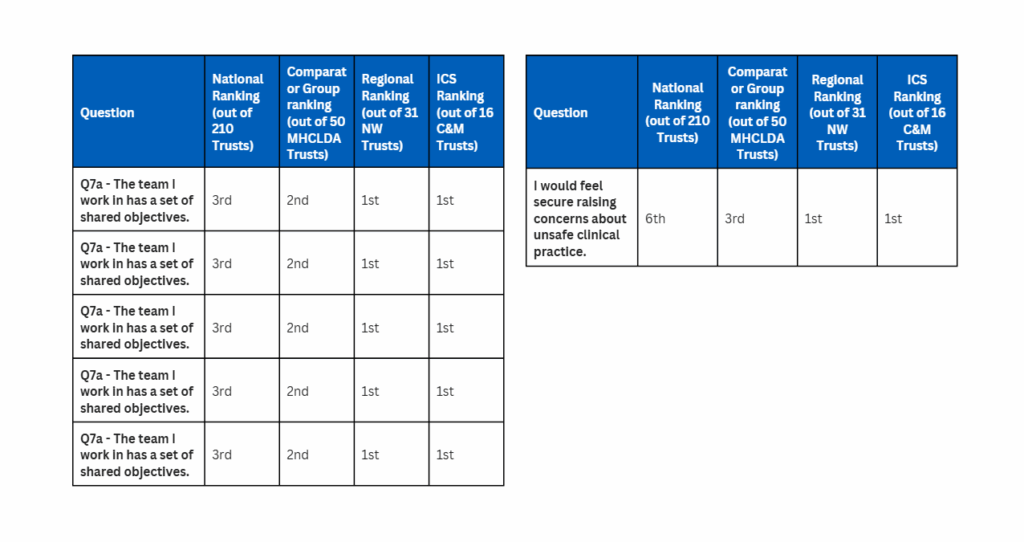
For the question, “I would feel secure raising concerns about unsafe clinical practice”, they rank as shown above.
They have had a decreasing turnover rate since Q2 24/25.
Key learnings
- Work has to be prioritised and strategically planned to sync with the trust strategy and operational plan, and delivered systematically.
- Plans are data and intelligence-led, and quantitative and qualitative data are triangulated and reviewed through the lens of both patient and staff experience
- The planning is strategically and operationally led by the Organisational Effectiveness Team and requires significant capacity and expertise.
- Integrating general staff experience, EDI, comms, and engagement supports a systematic approach.
- A coordinated approach across the Workforce Directorate and other teams, such as FTSU, clinical quality assurance and key stakeholders, to manage interdependencies.
- Organisational leaders must take ownership for fronting and operationalising Board to Ward.
- The importance of a persistent and specific focus on team leadership and team health to shift team culture, and having a consistent framework, support and resources to embed this (Mersey Care – Every Leader, Every Team).
- Corporate services can facilitate and provide specialist advice, but the real cultural and engagement work is done locally.
- Don’t assume big organisational change has to impact engagement and culture.
- If you ask for feedback, you need to be prepared to follow through on what comes back and communicate effectively on this: You Said, We Did.
- Psychological safety is fundamental for quality, safety and innovation.
Next steps
Mersey Care have an ambition to be in the top 20% of organisations in the Staff Survey by 2028. They will do this through continuous improvement and using data to drive outcomes. The Trust are currently reviewing experience and EDI data for every process, at every step of the employee lifecycle to understand and inform improvement action.
They intend to focus on wellbeing and sickness absence to improve workforce availability. They also want to continue focusing on the experience of global majority colleagues and continue their work to support their colleagues into leadership positions.
Contact information
Please contact; Jo Davidson, Deputy Director of Workforce; Organisational Effectiveness,
Or
Jayne Toole, Strategic Organisational Effectiveness Lead,