“Is our biggest barrier not that we don’t know enough about racism, but that we’ve become comfortable doing things that leave racism undisturbed?”
Joy Warmington, Chief Executive, brap

We are incredibly grateful you joined us for the Driving Race Equity Conference. Your energy, ideas, and presence helped shape an important event. We hope the sessions sparked ideas and motivation that will help you drive race equity and embed anti-racist principles within your organisation.
To help you maintain momentum, we have gathered a collection of resources to assist you and your organisation on your leadership journey.
Race Equality, Hope and Momentum in Challenging Times by Fatima Khan-Shah
Hope is not passive optimism. Hope is created when people see progress and change.
Fatima Khan-Shah left delegates with this powerful call to action during her keynote at the Driving Race Equity Conference.
In her keynote, Fatima highlights the need for the North West region to be unapologetically anti-racist, moving from “we value diversity” to “we will identify and dismantle racism where it exists”.
Here are some key takeaways:
- Awareness needs to become insight, and insight needs to become action for change to happen.
- Policy is not real when it simply exists. It’s only real when it works. And personalisation matters because race intersects with other characteristics like gender and disability, making the experience of each individual unique.
- We need to support staff undertaking race equality work, and those who have experienced racism, through the framework of “Recognise”, “Respond”, “Recover”, “Reconnect” and “Resource”.
Mobilising integrated care systems for racial equity | Panel
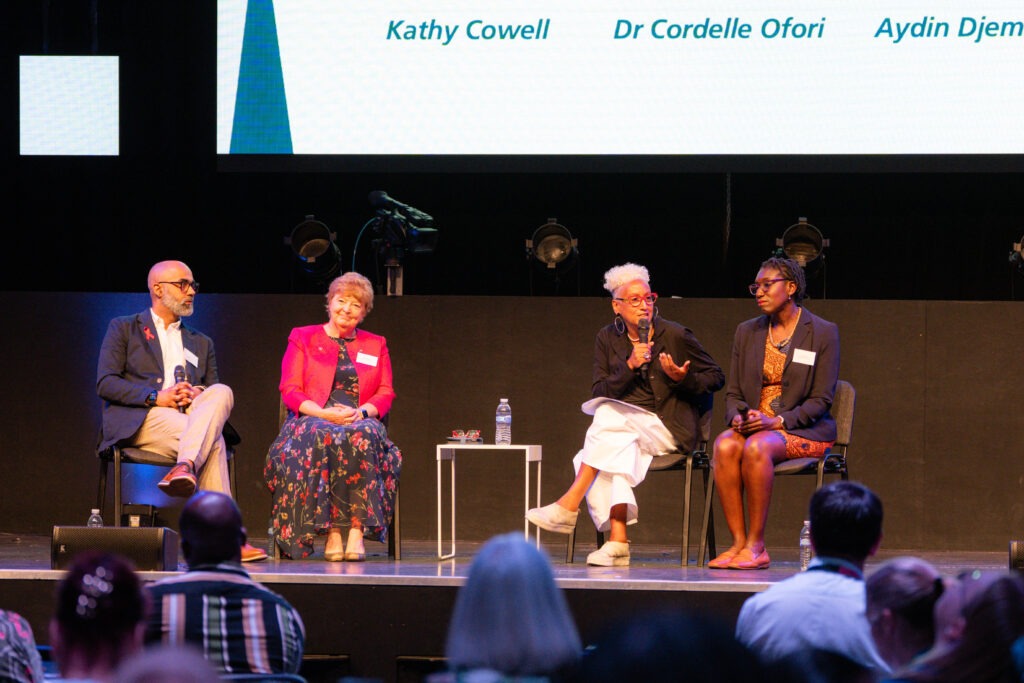
What does courageous leadership look like when it comes to advancing racial equity?
This was the key question explored during the morning panel at the Driving Race Equity Conference, chaired by Joy Warmington and joined by Dr Cordelle Ofori FFPH, Kathy Cowell and Aydin Djemal.
Find your motivation for change. Dr Cordelle Ofori reminded us that lasting change requires leaders to understand what motivates them to act. Good allies continually ask: “Could racism be playing out in this problem?” If we don’t ask the question, we risk overlooking the issue altogether.
Kathy Cowell reflected on the importance of engaging with staff networks to better understand colleagues’ experiences. Creating cultures where people feel safe to speak up, being vocal about expectations, and actively developing diverse talent in senior leadership are all essential to breaking down barriers.
Make courage a habit, not a moment. Aydin Djemal spoke about the need to be “stubborn with your courage”. Motivation will change and fluctuate, but addressing racial inequity must become part of how we lead every day, not something we return to only when it feels urgent.
Measure what matters. Completing an action plan is not the same as achieving change. As Dr Cordelle Ofori challenged us, we should continually ask ourselves and our peers: “Have outcomes improved? Have we seen the change we were aiming to achieve?“
Advancing race equity requires more than good intentions; it requires partnership and system-level action.
Race equity in health and care: Tackling the ‘causes of the causes’ by Professor Habib Naqvi
Addressing the importance of driving meaningful change, Prof Habib Naqvi MBE, Chief Executive of the NHS Race and Health Observatory, sheds light on the inefficiencies in healthcare caused by systemic racism.
The economic cost of racism and inaction is hard to overlook. Habib shares that by addressing the root causes of racial health inequities, we can improve outcomes and the financial sustainability of the NHS.
So where should NHS organisations stand when it comes to racial and ethnic equity?
This evidence-based model, consisting of 7 principles, is a good start to think about the practical steps needed for improvements:
- Name racism.
- Demonstrate leadership.
- Focus on data and evidence.
- Value lived experience insight.
- Use evidence-based interventions.
- Foster transparency and accountability.
- Promote wellbeing and cultural safety.
From insight to action – Race equity in practice by Modupe Dosunmu
Delegates reflected on the learning and impact of the Liverpool City Region Race Equality Hub Shadowing Programme. Funded by the Liverpool City Region Combined Authority Race Equality Hub and delivered in partnership with GraceHola LTD, the programme brought together partners from across sectors to advance diversity and inclusion in leadership across the system.
The programme has fostered meaningful cross-sector collaboration, creating opportunities for shared learning, stronger relationships, and positive change across Cheshire and Merseyside.
Transforming anti-racist practice through dialogic spaces breaking the silence by Kash Haroon
Organisational change happens when conversations change, and that authentic dialogue creates the conditions necessary for courage, learning and action.
This workshop highlighted that anti-racism is not only about policies and metrics but also about human connection, empathy and understanding lived experiences.
One of the strongest messages was that allyship is demonstrated through action rather than intention. Effective anti-racist leadership requires developing capability across three areas:
- Knowing (understanding communities and systems),
- doing (challenging bias, developing talent and adapting practice),
- and being (curiosity, openness to challenge and creating belonging).
Leaders need to move beyond silence, build confidence in having difficult conversations and actively challenge behaviours and systems that perpetuate inequity.
Download slidesInclusive reciprocal mentoring – The best it can be by Sonia Sarah and Naveed Sharif
Inclusive reciprocal mentoring is a mutually beneficial non-hierarchical partnership that positions participants as equal learning partners.
Benefits for senior leaders include:
- Unfiltered insights into lived experiences.
- Develop compassionate leadership.
- Identify workplace roadblocks.
- Challenges traditional hierarchies.
Benefits for underrepresented colleagues:
- Amplified confidence and a greater sense of belonging.
- Accelerated leadership development.
- Enhanced career visibility.
- High-level professional networking.
Maintaining momentum: The Anti Racist Framework by Ayo Barley and Lisa Shoko
The Anti-Racist Framework is a practical mechanism for maintaining momentum towards race equity through structured accountability. Rather than relying on good intentions alone, the framework measures organisational maturity, identifies gaps, promotes transparency, and links progress to clear deliverables. Evaluation findings highlighted the need for organisations to move beyond awareness and focus on embedding anti-racist practices into everyday leadership, workforce processes and patient care.
Liverpool Women’s Hospital NHS Foundation Trust has been on an anti-racism journey and has demonstrated how leadership commitment, dedicated investment, listening to lived experience, and treating racism as a patient safety and workforce risk can lead to tangible improvements.
Download slidesKeeping it real | The Lord Mann Report and NHS Staff Standards by Abid Dar
Exploring the findings of the Lord Mann Review and the newly introduced NHS Staff Standards, Abid Dar, Regional Head of Inclusion and Engagement, NHS England North West, frames racism, violence and sexual misconduct as major workforce, culture and patient safety risks. Leaders must move beyond compliance and demonstrate visible action that creates safer, fairer and more trusted workplaces. Staff experience is now positioned as a core leadership accountability issue, supported by formal standards and oversight mechanisms.
The focus for the organisations should be on prevention, safe reporting, fair investigation, effective support and visible learning rather than creating separate workstreams. The Leaders will ultimately be judged not by policies or reports, but by whether staff experience safer workplaces, greater trust in leadership, and meaningful change in their day-to-day working lives.
Download slidesBeyond hope and referral – Fixing the one small thing by Professor Abdul Razaq
What does anti-racist leadership look like in practice?
Professor Abdul Razaq, Director of Public Health at Blackburn with Darwen Council, shared a set of powerful principles for leaders committed to advancing racial equity:
Ask why. Challenge assumptions and seek to understand the root causes of inequity, rather than accepting outcomes at face value.
Learn and unlearn. Effective leadership requires a willingness to continually develop, reflect and challenge long-held beliefs and behaviours.
Get comfortable asking uncomfortable questions. Honest conversations are essential if organisations are to identify and address systemic racism.
Allow yourself to feel, but don’t get stuck in the feelings. Discomfort is part of the learning process. The challenge is to channel those emotions into meaningful action.
Lead with humility. Recognise that no one has all the answers. Creating lasting change means being willing to ask for help, listen to others and work collaboratively to develop solutions.
A powerful reminder that anti-racist leadership is not about having all the answers, it’s about having the courage, curiosity and humility to keep learning, asking questions and taking action.
Download slidesNew frontiers of racism by Majid Hussain
Grounded in current workforce data, Majid Hussain examines racism as it operates today. On many occasions, racism is evolving faster than many leadership responses.
The prejudice is not new. What shifts is the permission: How openly it can be said, and how little it costs to say it.
So how do these harmful narratives become normalised?
It often starts small, with an idea most people would reject circulating at the fringe. It gets repeated in online feeds, headlines and conversations. It then begins to sound normal, where people repeat it as ‘common sense’, and it goes unchallenged. It ultimately shapes actions where people would say it openly in the face of others and still expect it to go unchallenged.
From rumour, avoidance, discrimination, physical attack, to extermination, the 5 stages in Allport’s Scale of Prejudice have not changed, but the speed of escalation has.
What’s driving the change are the forces listed below, cutting across every frontier:
- AI can reproduce and amplify racial bias.
- Migration narratives shape perceptions of who belongs and who is deserving.
- Public discourse affects what feels sayable and how communities engage with services.
- Social media can spread misinformation at unprecedented speed.
- Politics influences what organisations prioritise, challenge, and feel confident discussing publicly.
Wrapping up the session, Majid has shared a touching video from the NHS Greater Manchester campaign, reiterating that there should be no space for racism in healthcare. Anywhere.
Additional resources
Read our latest blogs:
Building anti‑racist leadership in the NHS: a North West perspective
Breaking the silence – one conversation at a time
Listen to our podcast episode on Spotify: