Aislinn O’Dwyer: A journey through the NHS, leadership, and the power of public health
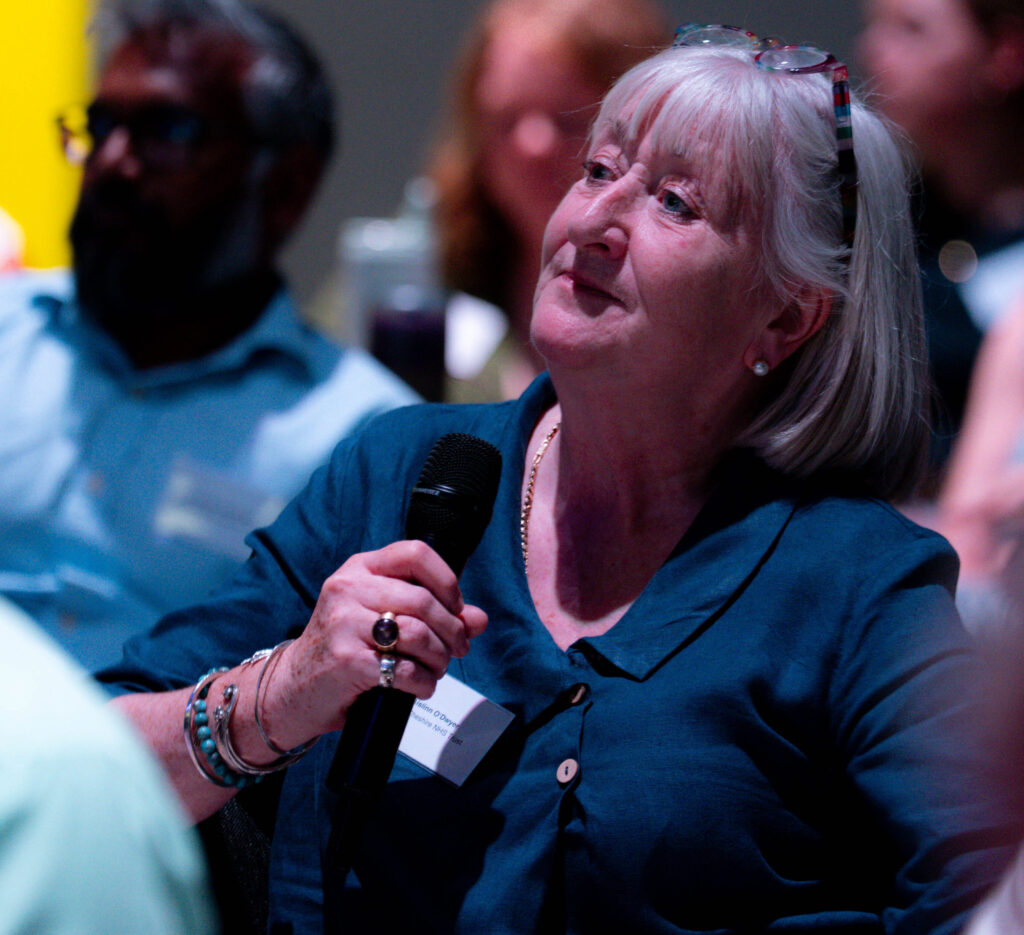
Aislinn O’Dwyer, Chair, East Cheshire NHS Trust, has had a remarkable journey through the NHS, spanning five decades and encompassing a wide range of roles. From her early days as a nurse and midwife to her current position as a non-executive director and chair, Aislinn’s career has been defined by her unwavering commitment to public health, her belief in the power of prevention, and her innovative approach to leadership. In this article, we explore Aislinn’s journey, her reflections on NHS leadership, and her approach to chairing NHS boards.
A family legacy in the NHS
Aislinn’s connection to the NHS runs deep, almost from birth. Her father was a general practitioner (GP) who joined the NHS shortly after its inception in 1948. Reflecting on the NHS’s 75th anniversary, Aislinn realised that the NHS was only eight years old when she was born.
“My father was a GP and, as a child, I was taught how to answer the telephone properly because it could have been a patient. In those days when people phoned the GP out of hours, it was at their home.”
This early exposure to the NHS instilled in her a profound respect for the service and its mission. Aislinn’s career began in Oxford, where she trained as a nurse, midwife, district nurse, and health visitor.
“I had a fabulous career in a fabulous environment, and wonderful mentors.”
Among her mentors was Sir Muir Gray, CBE, who played a pivotal role in shaping her career.
“Sir Muir Gray brought me into public health. In 1989, I came up to the North West, to the University of Liverpool to study a Master’s in Public Health. At the end of that, it was suggested that there could be a job for me at the university running the Master’s programme, but I didn’t want to leave the NHS. My values and everything sat very firmly with the NHS, and I loved working in the NHS, so I ended up working part time at the university and part time at what was Mersey Regional Health Authority, as a public health and primary care advisor”.
The shift to public health
Aislinn’s transition into public health was a natural progression, driven by her belief in the importance of prevention and community engagement.
“Public health is about community engagement, collaboration, tackling health inequalities, multidisciplinary working and working with the voluntary sector. It’s the whole breadth of those activities that really caught me.”
Aislinn’s work in public health was significant, particularly in her efforts to promote multidisciplinary training.
“Prior to 1989, you had to be a doctor to train in public health, but Liverpool set up the first multidisciplinary public health master’s programme in the country, and I was determined to drive that training forward. When I was doing my Master’s in Public Health I spent some time in the USA, at the encouragement of Sir Muir Gray, visiting universities like Harvard, Boston and Yale to see how they taught public health. They had such diverse cohorts of health professionals and other professional like architects and activists. All this fed into my conviction that multidisciplinary training and working is the direction we should be heading in.”
Despite opposition from some, Aislinn continued to advocate for multidisciplinary training, believing that it was essential for the future of public health. Her efforts paid off in 2002 when legislation changed, allowing non-medical professionals to become directors of public health. Aislinn was one of the first non-medical directors appointed in the country, taking on the role in West Lancashire.
“It was a national directive, but most parts of the country didn’t take advantage of it because they hadn’t established the training programmes. We had been running a multidisciplinary training course for eight or nine years, so we had a talent pipeline of trained public health professionals.”
Throughout her career, Aislinn has been a staunch advocate for prevention and community care. She believes that the NHS must focus more on prevention if it is to meet the growing demand for healthcare services.
“If we don’t work on the public health stuff, if we don’t focus more on prevention, we’re never going to be able to provide enough care in the hospital. We’ve got to find the mechanisms to really focus on prevention.”
Aislinn’s belief in the power of prevention is rooted in her early experiences as a district nurse and health visitor.
“As a district nurse, I was looking after lots of elderly people in rural Oxfordshire. I was going into homes and seeing people with leg ulcers that were getting worse. I was dressing them and thinking, these could be prevented.”
This experience, combined with her work on the Oxford Prevention of Heart Attack and Stroke project, reinforced her belief in the importance of systematic screening and early intervention.
“The Oxford Prevention of Heart Attacks and Strokes project was based on a Royal College of Physicians report that said, “half of all strokes and a quarter of all deaths from coronary heart disease are probably preventable by the application of existing knowledge.” We did a research project to see if systematic screening in general practice could identify those at risk of heart disease and manage hypertension to prevent strokes, and it could and did! That was in 1984.
From public health to NHS acute and community
Aislinn’s leadership journey within the NHS has been marked by a series of significant roles, each building on her expertise in public health and her commitment to prevention. After her time as director of public health in West Lancashire, she took on various interim roles, including interim director of public health in Blackburn with Darwen. She also worked closely with the regional director of public health.
Aislinn also went to Sierra Leone to help contain the spread of the Ebola virus outbreak.
“I was out there for about 6-7 weeks working with the NHS team at the Ebola treatment centres, which was an insightful experience. The contribution made by NHS staff, and the army was incredible.”
In 2018, Aislinn took on a non-executive director role at Mersey Care NHS Foundation Trust, where she chaired the People Committee and was a member of the Quality Committee.
“I was very engaged in the work they were doing on a ‘just and learning culture’.”
“Mersey Care got the benefits of my experience in Sierra Leone because when the COVID pandemic started, I was trained for a pandemic. I shared my learning, such as the importance of having an Ethics Committee when making decisions, because you know from day one, there’s going to be an inquiry. So, we made sure that we are doing things in a way that they should be done and that was good, particularly in a mental health setting, because the decisions we were having to make were really challenging.”
Aislinn’s leadership journey took another significant turn when she became chair of East Cheshire NHS Trust in March 2022.
“The attraction of this post was that it was an acute and community trust. I came in very explicitly saying I want to develop the integration between acute and community care and drive prevention.”
Mentorship and leadership development
Aislinn’s leadership journey has been shaped by the mentors who guided her along the way. Sir Muir Gray, in particular, played a crucial role in her early development.
“Muir is an amazing person. He’s always ten steps ahead of everybody else in his thinking. He taught me about management and the importance of having objectives.”
One of the most valuable lessons Aislinn learned from Sir Muir Gray was the importance of setting personal goals and using appraisal time wisely.
“I remember going through my performance review with him and he asked, ‘What’s the objective for you?
And I said, ‘What do you mean?’
He said, ‘The one that on a Friday afternoon when you don’t feel like doing anything else, that will keep you in the office.’
I said I’d really love to present our work at a big international conference.
He said, ‘Fine, put it down in the paperwork. If it’s down there, we can talk about it.’
And I did. I went to the USA and presented our work at a large International health promotion conference.”
This experience not only boosted Aislinn’s confidence but also reinforced her belief in the value of mentorship.
“Mentorship is crucial for aspiring leaders. It’s about having someone who can guide you, challenge you, and help you see opportunities you might not have considered.”
Mentoring
The NHS North West Leadership Academy has recognised the importance of mentoring in leadership development and building an inclusive workforce by establishing a Coaching and Mentoring Hub, which can support people within the NHS to find and establish mentor relationships. In addition to this, the NHS North West Leadership Academy commissions Mentor Development Programmes to ensure a steady stream of competent and confident mentors in the NHS North West Workforce.
Chairing NHS boards
As chair of East Cheshire NHS Trust, Aislinn brings an inclusive and dynamic approach to board leadership.
“My approach is to be inclusive. It means giving everybody the opportunity to have their voice heard. If they’re not speaking up, I will look to bring them in.”
“You need to be authentic in your leadership style because when you are a chair their isn’t a ‘how to guide’, you simply do the best you can and what you feel is right based on the evidence and then get feedback from others on your approach and work from there. The feedback is important because I would hate to think that what I was doing was not being well received.”
“You should also be dynamic, which to me means being ambitious as a board and organisation and keeping pace with the environment around you. We have ambitions for the trust and the community, and I believe we should be articulating and communicating that ambition with others and not be cowed by fear of the vision we are setting.”
Aislinn also says that challenge is an important part of the chair role, but that chairs should be mindful of how they approach this.
“Healthy challenge is about being respectful of other people’s views and being courteous in the way that you ask questions. I’ve been on the receiving end of humiliation, and it’s not pleasant. Sometimes people think it shows they’re smart when they humiliate others but it’s not smart at all, it just gets in the way of collaboration. You can ask questions and challenge without humiliation.”
Aislinn’s approach to chairing boards is also characterised by her attention to detail.
“I read everything, particularly after spending time reviewing what happens when NHS boards miss important details. The NHS really needs to learn from its mistakes.”
This attention to detail allows her to ask the right questions and ensure that the board is making informed decisions. However, Aislinn is also mindful of the challenges faced by non-executive directors (NEDs).
“NEDs have a job description that is all things to all people. They’re expected to hold the executive team to account, get assurances on the business, conduct walkabouts and then triangulate the data. But with only three days a month, it’s hugely challenging.”
To address this, Aislinn has been working on streamlining board papers and ensuring that NEDs have the support they need.
“Recently I’ve approached our NEDs to discuss with them their responsibilities, and I’ve asked them to be open with me about whether they are being asked to do things that are beyond their capability or capacity.”
“We’re going to do an exercise to look at how we can strengthen the assurances we get without having to read War and Peace. It’s about being efficient and recognising that there’s a learning and development need for those who write the papers.”
Aislinn has also supports the NHS North West Leadership Academy’s development of the Navigating the non-executive director role case study toolkit as a resource to support chair’s and NEDs tackle the challenges of their unique role.
The importance of collaboration and breaking down hierarchies
Aislinn’s leadership philosophy is deeply rooted in collaboration and the breaking down of hierarchies.
“I’m interested in people and collaboration. Early in my career, I sat on a joint health committee for a city council, and I learned a few things about poor collaboration in that role. I discovered that the councillors would all meet and agree what they were going to agree on, prior to discussion at the committee, and I remember talking to the officer who serviced that committee, saying, ‘I can’t understand why we don’t ever have any conversation here. It’s like it’s all being stitched up beforehand.’ And he said, ‘Well, yes, it is.’ and I was really shocked that everybody would try and stitch up the decision-making before the meeting. So, things like that have driven how I do business.”
“I think hierarchy is a barrier to collaboration. You see it with medical professionals versus non-medical professionals, though this has been broken down a bit over latter years, but it still has a way to go. I believe people that learn together work together better, which is why I have advocated for multidisciplinary healthcare education across my career.”
“I have seen examples of attitudes within the system that senior leaders are more important than the frontline workers. No, they are not, they do a different job, but they are no more valuable than anyone else. I say this as someone who has worked at all levels within the NHS. I’m a member of the team and nothing more. I would say to other senior leaders that visibility and getting to know people throughout your organisation is very important for breaking down hierarchies and getting an honest discourse from our workforce.”
Aislinn, as the chair of a charity, also reflects on how organisational hierarchies can limit collaboration.
“Sometimes organisational hierarchies get in the way of collaboration. For example, a government organisation may not view themselves as equal to a VCFSE organisation, but more important. They don’t always see the value of the voluntary and faith sectors. I’m proud that we have over 200 volunteers at East Cheshire Trust. I value the work they do to support our patients and staff. The feedback I get from them is that it also enhances their lives. In fact, volunteering is one of the five steps to improve your health and well-being.”
“I am the chair of a charity called Savera UK, an organisation that aims to prevent honour-based abuse (HBA) and harmful practices. We do campaigning work and education initiatives for schools, communities and healthcare professionals. We’re a national charity based in Liverpool, and we provide direct intervention support for survivors of honour-based abuse and harmful practices within Merseyside and Cheshire, which is funded through a range of funders including the Big Lottery and local Police and Crime Commissioners. However, this was not always the case. When we first started campaigning, 15 years ago, people used to say ‘That doesn’t happen here, so we don’t need to invest in solving the issue’ but that belief was formed because no one had investigated HBA and harmful practices or collected any data. Now, we are getting 30 referrals a month. Clearly the issue was present, but without collaboration it was invisible and unaddressed.”
A lifelong commitment to the NHS
Aislinn O’Dwyer’s journey through the NHS is a testament to the power of passion, perseverance, collaboration and a preventative approach to healthcare. Her approach to leadership is characterised by inclusivity, attention to detail, and a willingness to challenge.
Aislinn believes that leadership development is crucial for the future of the NHS.
“We need to invest in our leaders and give them the tools they need to succeed, which means providing mentorship, creating opportunities for multidisciplinary learning, and ensuring that NEDs have the time and resources they need to do their jobs effectively.”
As the NHS continues to face significant challenges, Aislinn’s insights and experiences offer valuable lessons for current and future leaders.